
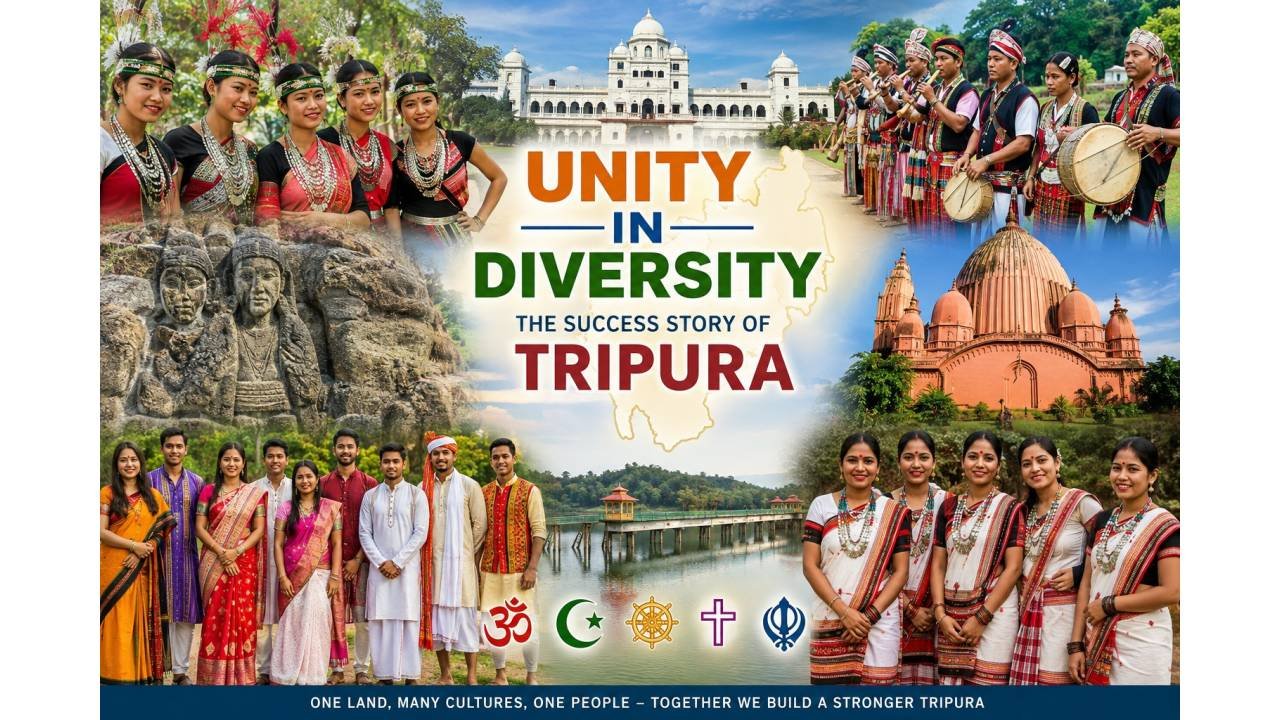
Unity in Diversity: The Case Study of Tripura’s Success Story
Tripura is the third-smallest state in India, covering an area of approximately 10,491 square kilometres. It is bordered by Bangladesh to the north, south, and west, and by the Indian states of Assam and Mizoram to the east. According to the 2011 Census, Tripura had a population of 3,671,032, constituting around 0.3% of India’s total population.
Tripura is one of the most culturally and socially diverse states in India. Its diversity can be seen in its geography, population, culture, religion, languages, food habits, and traditions. Whether one travels from North Tripura to South Tripura or from Dhalai to West Tripura, one encounters a remarkable variety of cultural and social practices within this relatively small state.
More than 30 percent of Tripura’s population belongs to Scheduled Tribes, while around 17 percent belongs to Scheduled Castes. The Scheduled Tribe population comprises 19 recognised tribes along with numerous sub-tribes and communities, each with its own culture, language, customs, food habits, and traditions. Similarly, the Scheduled Caste population consists of several communities, each with its own distinct social and cultural identity.
Tripura is also linguistically diverse. Bengali, Kokborok, Manipuri, Hindi, Garo, English, Punjabi, Odia, and several other languages are spoken in different parts of the state. Hinduism is the predominant religion, but Muslims, Buddhists, Christians, Jains, Sikhs, and followers of other faiths also live in Tripura. Different communities have their own traditions and styles of dress, further contributing to the state’s rich cultural diversity.
The important question, therefore, is: How is unity maintained among such a diverse population?
The answer lies largely in mutual respect, understanding, social interaction, and cultural accommodation. Rather than weakening Tripura, its diversity has become one of its greatest strengths. Several factors have contributed to maintaining social harmony in the state, including a relatively high literacy rate, the presence of media, folk culture, progressive cultural organisations, non-governmental organisations (NGOs), and various social and community groups.
Education has played an especially important role. A better-educated population is generally more capable of questioning rumours, misinformation, and attempts to create social divisions. Since rumours can often lead to misunderstanding and conflict between communities, education and awareness act as important safeguards for peace and social harmony.
Tripura also provides many examples of cultural assimilation. Mainstream Indian cultural elements coexist with traditional tribal cultures. There are Bengali-speaking people who understand and speak Kokborok, while many people of tribal origin are fluent in Bengali in addition to their mother tongue. Such linguistic and cultural exchanges have created bridges between communities.
Inter-caste and inter-tribal marriages have also contributed to social integration. Through continuous interaction and the sharing of cultural practices, different communities have influenced one another and contributed to the emergence of a broader and more inclusive social culture.
Thus, Tripura demonstrates that diversity and unity are not necessarily contradictory; rather, diversity can become the foundation of unity when it is respected and accommodated. The state’s experience suggests that attempts to impose excessive cultural or social uniformity on a heterogeneous society can undermine the very relationships that hold it together.
For Tripura, therefore, the “Unity in Diversity” model is particularly relevant to its social development. Any attempt to divide society along religious, caste, tribal, linguistic, or other lines could have serious consequences for social harmony and development. The progress of a society depends on its historical, cultural, economic, and social circumstances, and the model that works for one society may not necessarily be suitable for another.
The responsibility of the present generation is to preserve this valuable heritage of coexistence and pass it on to future generations. Tripura’s diversity should not be viewed as a weakness but as a source of strength, creativity, and social resilience. By respecting and protecting its diversity, Tripura can continue to strengthen its unity and build a peaceful and prosperous future.
Discussion